
Tell us about the property and the problem. We’ll follow up to schedule a site visit.
Commercial Property Services
Commercial Roof Repair
Leaks traced to the actual source, repaired, and documented — on flat and low-slope commercial roofs.
Flashing, seams, penetrations, drains, edge metal, and storm damage. Serving commercial property across the Midwest since 1996.
Why leaks come back
The stain is not the leak
A ceiling stain almost never sits directly under the hole that caused it. Water enters at a failed detail — a seam, a curb, a penetration — then runs along the deck, a joist, or the top of the insulation until it finds a way down. It can travel twenty or thirty feet before it shows up inside.
That is why patching the membrane above the stain fails so reliably, and why the tenant calls again after the next hard rain.
We get on the roof and trace the water back to where it is actually entering, then show you what we found before you approve a repair — and before anyone starts talking about replacing the whole system.
Roofs are also where deferred maintenance gets expensive fastest. A failed seam is a cheap repair while it is still a seam. Once water has been sitting in the insulation for a season, the same spot becomes a tear-off, and the ceiling, lighting, and flooring below it usually come along for the ride.
Most of our roofing work is repair and restoration rather than replacement. When a roof genuinely is at the end of its life, we will tell you — including when that answer costs us the smaller job.
Where leaks start
What actually fails on a commercial roof
Roughly in the order we find them on Midwest buildings. Very few leaks start in the middle of an open field of membrane.
Call 309-796-2222Every rooftop unit, vent, pipe, and skylight is a hole in the roof that was sealed afterward. Those seals are the single most common entry point we find.
Seams carry the stress of expansion and contraction through every temperature swing. Over time they lose adhesion, lift at the edge, or split outright.
Service techs, dropped tools, and dragged equipment put holes in membrane. Often the damage happens during a rooftop service call nobody connected to the leak.
Water still standing days after rain means drainage has failed. Ponding accelerates membrane breakdown and adds real weight to the structure.
Wind works at the perimeter hardest. Loose or lifted edge metal lets water under the membrane and is a leading cause of progressive wind damage.
A curb that was never resealed after an HVAC swap, or a satellite mount bolted straight through the membrane. These are among the most reliable sources of a brand-new leak.
What we do
Commercial roof repair services
Repair and restoration on the roof, plus the interior damage a leak leaves behind.
Call 309-796-2222- Leak investigation and source tracing
- Membrane patching and section repair
- Seam repair and re-welding
- Puncture and tear repair
- Wet insulation removal and replacement
- Temporary containment on active leaks
- Curb flashing at rooftop units
- Pipe boots, vents, and stacks
- Skylight and hatch flashing
- Wall and parapet flashing
- Edge metal, coping, and counterflashing
- Resealing after HVAC or equipment work
- Roof drain clearing and repair
- Scupper and overflow repair
- Ponding assessment and correction
- Gutters, downspouts, and leaders
- Tapered insulation at low spots
- Seasonal drain clearing
- Hail and wind damage repair
- Written condition reports for insurance
- Emergency tarping and dry-in
- Interior ceiling and drywall repair
- Insulation, lighting, and finish repair
- Spring and fall roof inspections
Systems we work on
Flat and low-slope roof systems
Not sure what you have? That is normal. We will identify it on the first visit.
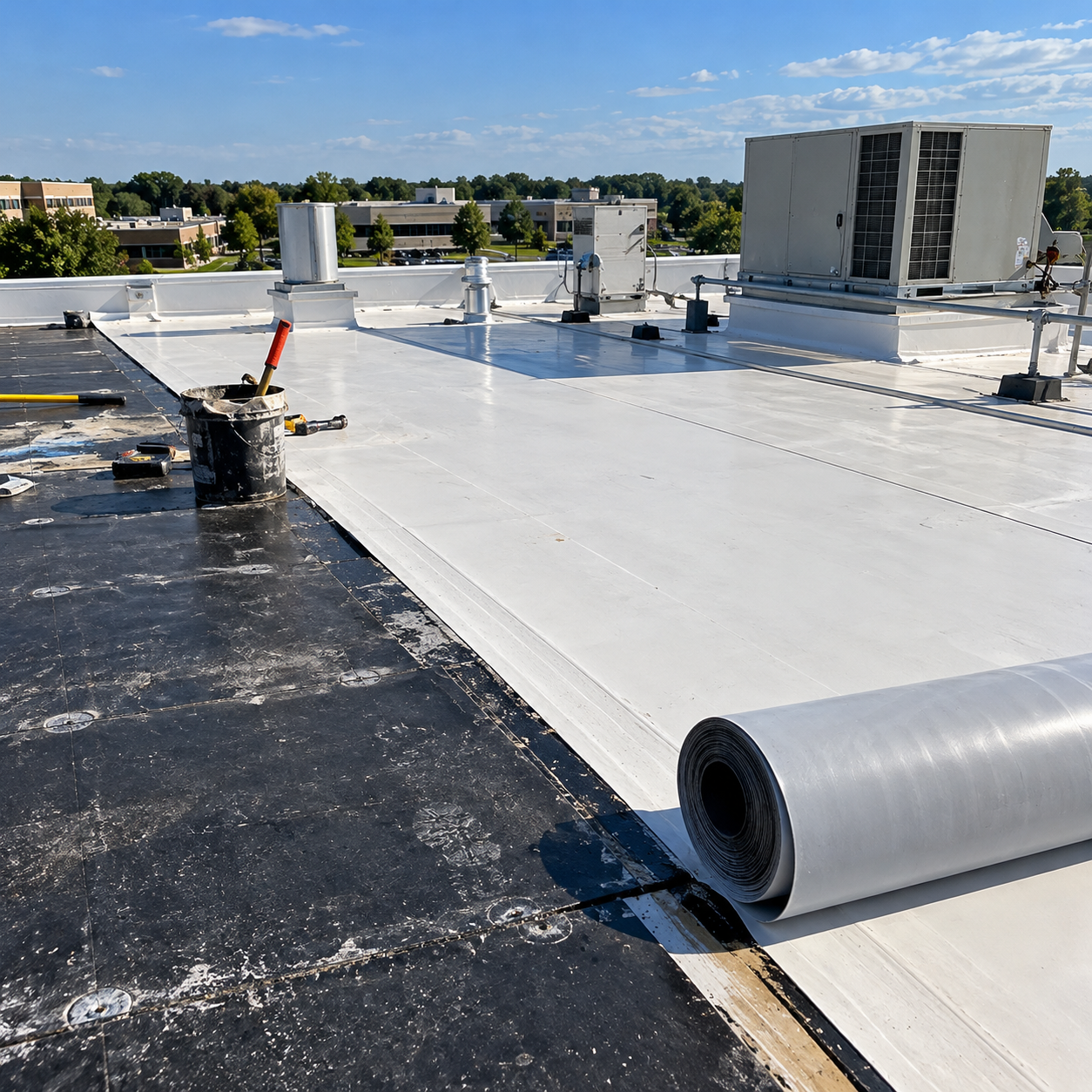
White single-ply membrane, heat-welded at the seams. Common on newer commercial buildings. Most repairs here are seams, punctures, and curb flashing.
Black rubber membrane, adhesive-seamed. Durable and widespread. Failures concentrate at seams, laps, and the detail work around penetrations.
Layered asphaltic systems, often with a granulated cap sheet or gravel. Repairs involve lap seams, blisters, splits, and flashing at walls and curbs.
Common on industrial and agricultural buildings. Leaks usually trace to fasteners, panel laps, transitions, and penetrations rather than the panel itself.
Buildings that grew in phases often have two or three systems meeting each other. Those transitions leak more than either system does on its own.
Mansards, entry canopies, and pitched sections on otherwise flat buildings. Usually valleys, step flashing, and the point where pitched meets flat.
The real question
Repair or replace?
Nobody can answer this from the ground, and anyone who answers it before getting on the roof is selling rather than assessing. Here is what we are actually looking at.
- Leaks trace to a handful of identifiable details
- Membrane is still pliable and well adhered across the field
- Insulation under the problem areas is dry
- Drainage works, with no long-standing ponding
- The system has useful service life left in it
- Problems are isolated rather than repeating everywhere
- The same failure is repeating across the whole roof
- Membrane is brittle, shrinking, or splitting on its own
- Insulation is saturated over a large area
- Ponding persists because the slope or deck has moved
- You are repairing the same roof several times a year
- Repair spend is approaching what a new system costs
Why West Maintenance
Why property managers call us for roof work
We find where water is actually entering before we price a repair. That is the step that separates a fix from a patch you pay for twice.
If the roof is finished, we say so. If it has years left, we say that too — even when the honest answer is the smaller invoice.
A leak damages drywall, tile, insulation, and lighting. We repair what is above and what is below on the same account.
Freeze-thaw, snow load, ice, and hail. Since 1996 we have learned which roof repairs survive a February here and which ones do not.
Storm damage comes with a written condition report you can hand to an adjuster, not a verbal description after the fact.
Single sites and multi-location portfolios run on one account, one contact, and one consistent standard.
How we work
Three steps from leaking to closed out
No contract required. Plenty of accounts start with one leak.
Call 309-796-2222Tell us where the water is showing up inside and when it started. If it is actively coming in, we can get out to contain it first.
We work back from the interior damage through the details that actually fail until we find the entry point, then scope the repair item by item.
The roof repair, plus the interior damage it caused, finished on schedule and documented for your records.
Common questions
Commercial roof repair FAQs
Not covered here? Call and ask — we would rather answer it on the phone than have you guess.
Call 309-796-2222How do you find a commercial roof leak?
By tracing it, not by guessing from the stain. Water that enters at a failed seam can run along the deck, a joist, or the top of the insulation for twenty or thirty feet before it finds a seam in the ceiling and drips. The wet spot inside is where the water came out, not where it came in.
We start above the interior damage, then work outward through the details that actually fail — penetrations, curbs, seams, flashing, and drains — until we find the entry point. That is the step most failed repairs skipped.
Why does my roof still leak after it was repaired?
Almost always because the patch went over the stain instead of over the source. Sealing the membrane directly above a ceiling spot is the most common repair there is, and it holds right up until the next hard rain.
The other frequent cause is a repair that addressed one failed detail on a roof where the same detail is failing in a dozen places. If every curb on the roof has the same flashing problem, fixing one of them buys you a few weeks.
What causes most commercial roof leaks?
In our experience on Midwest buildings, in rough order: flashing at penetrations and curbs, seam failure, punctures from foot traffic or dropped tools, blocked drains and ponding water, and edge metal that has pulled loose.
A disproportionate share trace back to rooftop equipment — a curb that was never resealed after an HVAC unit was serviced or replaced is one of the most reliable sources of a new leak we see.
Should I repair my roof or replace it?
It depends on four things: how old the system is, how much of its area is actually failing, whether the insulation underneath has taken on water, and whether the problems are isolated details or the same failure repeating everywhere.
An otherwise sound roof with three bad curbs is a repair. A roof where the membrane is brittle, the seams are opening across the field, and the insulation is saturated is a replacement, and patching it is money spent twice. We will tell you plainly which one you have, including when the answer costs us the smaller job.
How much does commercial roof repair cost?
There is no honest per-square-foot answer before someone gets on the roof. The same visible stain can be a two-hour flashing repair or a section tear-off with wet insulation underneath, and the difference is not visible from the ground or from inside.
What we can tell you is how the number gets built: we get on the roof, find the actual source, scope the repair item by item, and send a firm price. You approve before anything starts.
Do you work on flat and low-slope roofs?
Yes — that is most of what commercial property has. We repair TPO, EPDM, modified bitumen, built-up roofs, and metal, along with the flashing, edge metal, drains, and penetrations that go with them.
If you do not know what system you have, that is fine. We will identify it on the first visit.
Can you handle storm and hail damage?
Yes. Wind-lifted seams and hail bruising are easy to miss from the ground and matter a great deal to an insurance adjuster, so it is worth having the roof looked at after a significant storm even when nothing is leaking yet.
We document what we find in a written condition report you can hand to your carrier, and we handle the repair once the claim is settled.
My roof is leaking right now. What should I do?
Call 309-796-2222. Move anything valuable out from under it, put a container down, and leave the ceiling tile out so the water has somewhere to go instead of pooling above it.
Active leaks move faster by phone than through a form. We can get out to contain it, then come back and trace the source properly once it is dry enough to work.
How often should a commercial roof be inspected?
Twice a year is the standard that holds up — once in spring, once in fall. Those are the transitions that expose what a Midwest winter did and what the summer heat cycles opened up.
Also worth inspecting after any significant hail or wind event, and after any work that put people and equipment on the roof. Rooftop service calls are a common cause of new punctures and unsealed curbs.
Do you do roof replacements, or just repairs?
Repair and restoration is the bulk of our roofing work — leaks, flashing, seams, drains, and storm damage. When a roof is genuinely at the end of its life we will say so and walk you through the options rather than selling you another patch.
Roof work also tends to arrive with other items attached: interior ceiling and drywall repair after a leak, HVAC curb sealing, and gutter work. Those run on the same account — see all services.
Related services
Often handled on the same visit
A roof leak rarely stays on the roof. Interior repairs, HVAC curb work, and drainage go on the same bid.
All ServicesRequest a bid on commercial roof repair
Tell us where the water is showing up and when it started. We’ll follow up to schedule a site visit.
309-796-2222- We walk the site and assess the actual condition.
- You get a priced scope before any work starts.
- Emergency? Call the number above instead of filling this out.
Send the details and we’ll be in touch to schedule a site visit.
